The Double Shadow: A Clark Ashton Smith Podcast

Archive of Posts in "Episode"

Episode #11: “Mother of Toads”

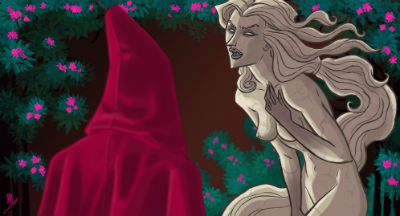
This week’s episode is on “Mother of Toads” (abridged version here). As with “Maker of Gargoyles,” we warn listeners that this story does contain sexual assault, in this case against a male.

IMDB page for The Theatre Bizarre in which the “Mother of Toads” adaptation Phil mentioned appears (and picture of Richard Stanley). A trailer for the horror compilation in which the “Mother of Toads” film appears The Theatre of the Bizarre. A clip in which the wife buys the Elder Sign earring.

The Dark Horse Book of Witchcraft, in which an illustrated (but not graphic novel/comic) version of “Mother of Toads” appears.

Next time, we will be reading “The Enchantress of Sylaire.”

Thanks again to Kevin MacLeod for the music.

Episode #10: “The Disinterment of Venus”

A transcription of this episode is now available.

This week is a somewhat shorter episode on Smith’s “Disinterment of Venus.” After a number of revisions, this story first appeared in the July 1934 issue of Weird Tales alongside “Through the Gates of the Silver Key” by HPL and E. Hoffman Price and other stories.

The goddess Smith had originally intended to conflate with this Venus was
Kotys (or “Cotys”, “Cotto”, “Cottyto”, “Cottytus” depending on the spelling). According to Brewer’s Dictionary of Phrase & Fable, her priests were called “Baptes”

[their] midnight orgies were so obscene that they disgusted even the even the goddess herself. (p.73)

Our next episode will be “Mother of Toads.” This one will carry a warning for sexual violence.

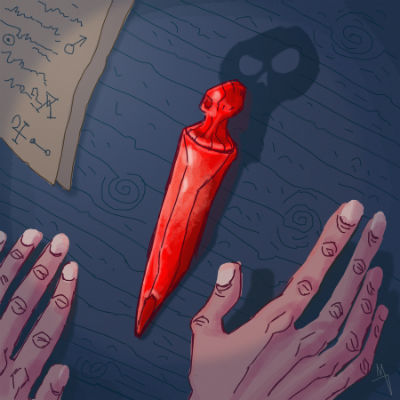
Music by: Kevin MacLeod, Illustration by Mike Mucci.

Episode #9: “The Holiness of Azédarac”

This week’s episode is on Clark Ashton Smith’s “The Holiness of Azédarac” (originally titled “The Satanic Prelate”). “Holiness” was published in Weird Tales in November of 1933.

Illustration of the Holiness of Azedarac

You can hear H.P. Lovecraft & Clark Ashton Smith discussing the history of Averoigne as used in this story in our two interludes: Lovecraft’s letter to CAS and Smith’s letter to HPL.

If you missed the allusions in the text, Iog-Sotôt is Yog-Sothoth of HPL fame and Sodagui is Tsathoggua of CAS’s pantheon/pandemonium. Both are undoubtedly CAS’s attempts to mimic the evolution of pronunciations through the centuries. Lilit is Lilith, first wife of Adam who is thought to be perhaps a demon or a monster.

Our next episode will be “The Disinterment of Venus.”

Special thanks to the Hay Library for being so friendly on our visit and to Mike Mucci for the Azédarac drawing!

Music by: Kevin MacLeod

Episode #8: “The Beast of Averoigne”

In this week’s episode, we’ll be covering The Beast of Averoigne in the version which was published in Weird Tales, May 1933. We’ll also be talking about the differences between this version and the one originally submitted to Weird Tales, which you may enjoy reading as well.

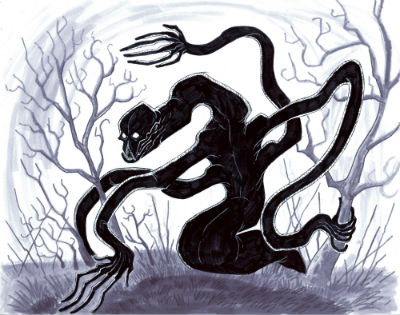
Illustration of the Beast of Averoigne

Beast of Averoigne illustration created by Mike Mucci.

The French Wikipedia entry on Chaudronnier (translated by Ruth) describes one was:

Chaudronnier is a trade originally describing pot-makers, which by extension came to describe anyone who makes hollow containers of metal or plastic of all kinds.

And as a reminder, we now have forums where you can talk about the episodes, Smithiana, weird gaming, and weird fiction in general!

Music by: Kevin MacLeod

Episode #7: “The Mandrakes”

A transcript of this episode is now available.

This week’s episode is on “The Mandrakes.” At the beginning of the episode, we noted a change in our line-up and an error we’d made regarding story order. The proper story order is reflected on our About page, although we kept Colossus where it had been and noted where it should have been.

The movie Phil referenced about a woman whose feelings flow into her cooking was Like Water for Chocolate (1992). The Japanese horror film was Cure (1997).

Information about Gilles de Rais can be found here. De Rais was also hanged, but the article does not mention whether or not his corpse was then burned.

The Winners of our Giveaway

Many congrats to the winners of our giveaway, whose “lost or unwritten Averoigne story” ideas were read on the podcast today:

From Jason:

In the decaying ruins of an unnamed abbey, a young woman finds a manuscript purporting to be a true and accurate account of the habits and deeds of the wild loup-garou. She returns to her village and becomes obsessed with proving the validity of the document (and the veracity of the existence of the feral beasts) to the disbelieving townsfolk, going so far as to maul an old woman in a manner consistent with the manuscript to provide “evidence.” She is caught and cast out of the village, wandering in madness through the primeval forest until, joyously vindicated at last, she meets her death on the claws and teeth of a loup-garou.

Guido:

In modern day Averoigne two friends embark on a road trip to sight see the horror haunted historical sights of the Averoignian countryside. Their adventure turns perilous when they realize that their journey is closely tailed by a stalking, flesh-hungry werebeast and they have to keep moving to survive.

Janey:

A highwayman is hiding out in the woods of Averoigne at night when he comes upon a young woman; she tells him a disturbing story about a village whose inhabitants were picked off one by one by a loup-garou. At the end of the story the girl reveals that she herself was the loup-garou, and devours him.

Pete:

The body of a sorcerer washes up on the shore of the Isoile River; whispers of his death begin surfacing around Averoigne and of the binding spell that died with him. Now free from the sorceries that imprisoned their shapeshifting abilities, an ancient family attempt to reclaim their wolfen birthright.

Thanks to all the listeners who submitted and promoted the contest!

Next time, we’ll be doing the published version of “The Beast of Averoigne.” For extra credit, though, read the original version of the story to understand the style he first intended and get a little more background than we’re given in the final version.

Music by: Kevin MacLeod and T.H. Larsen/Gracehoper (with permission) Egypt-style soundscape and Southern Gothic.

Episode #6: “The Colossus of Ylourgne” pt.2

A transcript of this episode is available.

In this week’s episode, we finish “The Colossus of Ylourgne,” sections 5-8. Our site’s moved hosting, but we’re in the same spot on iTunes and our feed hasn’t changed. If you’re experiencing redownloaded episodes, that may occur because of the feed change.

Merriam-Webster defines an “oubliette” as a dungeon with a hole only at the top. Prisoners go in, they don’t come out. Unless it’s an ill-maintained oubliette. One example of an oubliette.

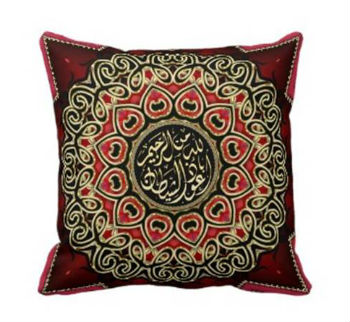
The phrase “Saracenic,” which was used several times to refer to Nathaire and to his surroundings, generally has an Arabic and Muslim connotation. The meaning, however, varies widely and could refer to Muslims at the time of the crusades, to Muslim art and architecture in Spain, to Muslim art and architecture in India, etc. In art and architecture (and furniture), it often contained intricate geometric designs that didn’t generally represent persons or even animals (as forbidden by strict Islamic practice). We couldn’t find an image of a Saracenic cushion, but one might imagine ornate and colorful designs.

Edited to add: Thanks to the reader who set us this pic of a saracenic cushion!

The story of two human-formed colossi, mentioned by Phil, is “In the Hills, the Cities” from Clive Barker’s Books of Blood. The Hellboy story which was inspired by Colossus, called “Almost Colossus,” can be found in Hellboy collection #3: The Chained Coffin and Others. Lots of good stories in both those collections.

Next week, we’ll be talking about “The Mandrakes.”

Music by: Kevin MacLeod